
pyproximal.optimization.primal.AndersonProximalGradient#
- pyproximal.optimization.primal.AndersonProximalGradient(proxf: ProxOperator, proxg: ProxOperator, x0: ndarray[tuple[Any, ...], dtype[_ScalarT]], epsg: Union[float, ndarray[tuple[Any, ...], dtype[_ScalarT]]] = 1.0, tau: Union[float, ndarray[tuple[Any, ...], dtype[_ScalarT]]] = 1.0, niter: int = 10, nhistory: int = 10, epsr: float = 1e-10, safeguard: bool = False, tol: Optional[float] = None, callback: Optional[Callable[[ndarray[tuple[Any, ...], dtype[_ScalarT]]], None]] = None, show: bool = False) ndarray[tuple[Any, ...], dtype[_ScalarT]][source]#
Proximal gradient with Anderson acceleration
Solves the following minimization problem using the Proximal gradient algorithm with Anderson acceleration:
\[\mathbf{x} = \argmin_\mathbf{x} f(\mathbf{x}) + \epsilon g(\mathbf{x})\]where \(f(\mathbf{x})\) is a smooth convex function with a uniquely defined gradient and \(g(\mathbf{x})\) is any convex function that has a known proximal operator.
- Parameters
- proxf
pyproximal.ProxOperator Proximal operator of f function (must have
gradimplemented)- proxg
pyproximal.ProxOperator Proximal operator of g function
- x0
numpy.ndarray Initial vector
- epsg
floatornumpy.ndarray, optional Scaling factor of g function
- tau
floatornumpy.ndarray, optional Positive scalar weight, which should satisfy the following condition to guarantees convergence: \(\tau \in (0, 1/L]\) where
Lis the Lipschitz constant of \(\nabla f\). N ote that \(\tau\) can be chosen to be a vector when dealing with problems with multiple right-hand-sides- niter
int, optional Number of iterations of iterative scheme
- nhistory
int, optional Number of previous iterates to be kept in memory (to compute the scaling factors
- epsr
float, optional Scaling factor for regularization added to the inverse of :math:mathbf{R}^T mathbf{R}`
- safeguard
bool, optional Apply safeguarding strategy to the update (
True) or not (False)- tol
float, optional Tolerance on change of objective function (used as stopping criterion). If
tol=None, run untilniteris reached- callback
callable, optional Function with signature (
callback(x)) to call after each iteration wherexis the current model vector- show
bool, optional Display iterations log
- proxf
- Returns
- x
numpy.ndarray Inverted model
- x
Notes
The Proximal gradient algorithm with Anderson acceleration can be expressed by the following recursion [1]:
\[\begin{split}m_k = min(m, k)\\ \mathbf{g}^{k} = \mathbf{x}^{k} - \tau^k \nabla f(\mathbf{x}^k)\\ \mathbf{r}^{k} = \mathbf{g}^{k} - \mathbf{g}^{k}\\ \mathbf{G}^{k} = [\mathbf{g}^{k},..., \mathbf{g}^{k-m_k}]\\ \mathbf{R}^{k} = [\mathbf{r}^{k},..., \mathbf{r}^{k-m_k}]\\ \alpha_k = (\mathbf{R}^{kT} \mathbf{R}^{k})^{-1} \mathbf{1} / \mathbf{1}^T (\mathbf{R}^{kT} \mathbf{R}^{k})^{-1} \mathbf{1}\\ \mathbf{y}^{k+1} = \mathbf{G}^{k} \alpha_k\\ \mathbf{x}^{k+1} = \prox_{\tau^{k+1} g}(\mathbf{y}^{k+1})\end{split}\]where \(m\) equals
nhistory, \(k=1,2,...,n_{iter}\), \(\mathbf{y}^{0}=\mathbf{x}^{0}\), \(\mathbf{y}^{1}=\mathbf{x}^{0} - \tau^0 \nabla f(\mathbf{x}^0)\), \(\mathbf{x}^{1}=\prox_{\tau^k g}(\mathbf{y}^{1})\), and \(\mathbf{g}^{0}=\mathbf{y}^{1}\).Refer to [1] for the guarded version of the algorithm (when
safeguard=True).
Examples using pyproximal.optimization.primal.AndersonProximalGradient#
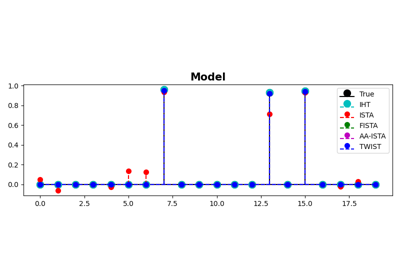
IHT, ISTA, FISTA, AA-ISTA, and TWIST for Compressive sensing