
Note
Go to the end to download the full example code.
Dykstra’s algorithms#
This example showcases two closely related tasks:
projection onto an intersection of convex sets using the Dykstra’s projection algorithm;
proximal operator of a sum of proximable functions using the Dykstra-like proximal algorithm.
import matplotlib.pyplot as plt
import numpy as np
from matplotlib.colors import to_rgba
from matplotlib.patches import Circle, Rectangle
from pylops import MatrixMult

from pyproximal.projection import BoxProj, EuclideanBallProj, GenericIntersectionProj
from pyproximal.proximal import L1, L2, Box, EuclideanBall, GenericIntersectionProx, Sum

rng = np.random.default_rng(10)
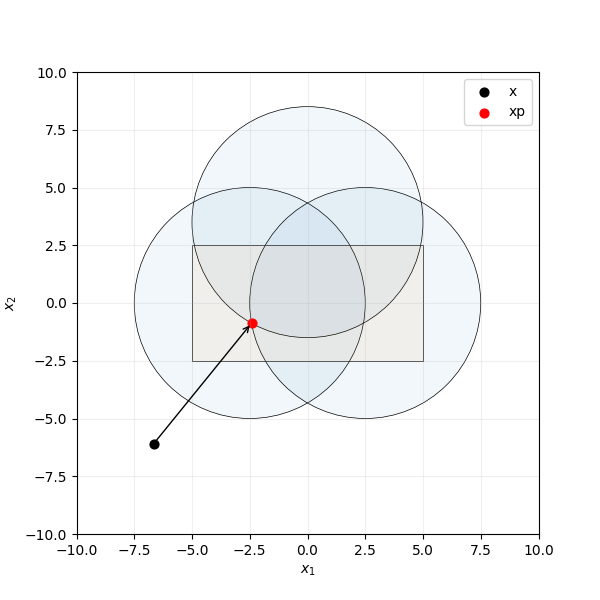
Here is an example of a projection onto the intersection of convex sets
using pyproximal.projection.GenericIntersectionProj.
circle_1 = EuclideanBallProj(np.array([-2.5, 0.0]), 5)
circle_2 = EuclideanBallProj(np.array([2.5, 0.0]), 5)
circle_3 = EuclideanBallProj(np.array([0.0, 3.5]), 5)
box = BoxProj(np.array([-5.0, -2.5]), np.array([5.0, 2.5]))

projections = [circle_1, circle_2, circle_3, box]
dykstra_proj = GenericIntersectionProj(projections)

x = rng.normal(-5.0, 1.5, size=2)
print("x            =", x)

xp = dykstra_proj(x)

print("x projection =", xp)
x            = [-6.65500767 -6.08753696]
x projection = [-2.42308404 -0.87363278]
Let’s now see how \(\mathbf{x}\) is projected to \(\mathbf{x_p}\).
fig, ax = plt.subplots(figsize=(6, 6))

circles = [
    ((-2.5, 0.0), 5.0),
    ((2.5, 0.0), 5.0),
    ((0.0, 3.5), 5.0),
]
for (cx, cy), r in circles:
    ax.add_patch(
        Circle(
            (cx, cy),
            r,
            facecolor=to_rgba("C0", 0.06),
            edgecolor="k",
            linewidth=0.5,
            linestyle="-",
        )
    )

xmin, ymin = (-5.0, -2.5)
xmax, ymax = (5.0, 2.5)
ax.add_patch(
    Rectangle(
        (xmin, ymin),
        xmax - xmin,
        ymax - ymin,
        facecolor=to_rgba("C1", 0.06),
        edgecolor="k",
        linewidth=0.5,
        linestyle="-",
    )
)

ax.scatter(x[0], x[1], s=40, c="k", marker="o", label="x")
ax.scatter(xp[0], xp[1], s=40, c="red", marker="o", label="xp")
ax.annotate(
    "",
    xy=(xp[0], xp[1]),
    xytext=(x[0], x[1]),
    arrowprops={"arrowstyle": "->", "color": "k"},
)

ax.set_aspect("equal", adjustable="box")
ax.set_xlim(-10, 10)
ax.set_ylim(-10, 10)
ax.set_xlabel(r"$x_1$")
ax.set_ylabel(r"$x_2$")
ax.grid(alpha=0.2)
ax.legend()

plt.show()
Similarly, we can use the pyproximal.GenericIntersectionProx to
perform the same projection onto the intersection of convex sets; this is
usually the preferred choice when we want to pass proximal operators of
indicator functions to any of our proximal solvers.
# projection functions
circle_1 = EuclideanBallProj(np.array([-2.5, 0.0]), 5)
circle_2 = EuclideanBallProj(np.array([2.5, 0.0]), 5)
circle_3 = EuclideanBallProj(np.array([0.0, 3.5]), 5)
box = BoxProj(np.array([-5.0, -2.5]), np.array([5.0, 2.5]))

projections = [circle_1, circle_2, circle_3, box]
dykstra_prox = GenericIntersectionProx(projections)

x = rng.normal(0.0, 3.5, size=2)

print("x            =", x)
print("Is x inside?", dykstra_prox(x))  # x is outside

xp = dykstra_prox.prox(x, 1.0)

print("x projection =", xp)
print("Is x inside?", dykstra_prox(xp))  # xp is inside
x            = [-2.7363184  0.9344155]
Is x inside? False
x projection = [-2.42224218  0.87836893]
Is x inside? True
Note that with an abuse of notation, the same projection
can also be performed using pyproximal.Sum (i.e., the sum of indicator
functions of the projections). Whilst this is possible, we reccomend using
pyproximal.GenericIntersectionProx when dealing with indicator
functions for improved code clarity.
# indicator functions
circle_1 = EuclideanBall(np.array([-2.5, 0.0]), 5)
circle_2 = EuclideanBall(np.array([2.5, 0.0]), 5)
circle_3 = EuclideanBall(np.array([0.0, 3.5]), 5)
box = Box(np.array([-5.0, -2.5]), np.array([5.0, 2.5]))

projections = [circle_1, circle_2, circle_3, box]
dykstra_sum = Sum(projections)  # sum of indicator functions

x = rng.normal(0.0, 3.5, size=2)

print("x            =", x)
print("Is x inside?", dykstra_sum(x))  # x is outside

xp = dykstra_sum.prox(x, 1.0)

print("x projection =", xp)
print(
    "Is x inside?", dykstra_sum(xp)
)  # note that round-off error may leave it marginally infeasible.
x            = [-0.87003255  0.44269068]
Is x inside? True
x projection = [-0.87003255  0.44269068]
Is x inside? True
Finally, let’s use pyproximal.Sum in the correct way, i.e. with
proximable functions. This will compute the proximal operator of the sum of the
functions we have passed. Note that the reason why we have shown
pyproximal.GenericIntersectionProx and pyproximal.Sum is
that under the hood they both rely on similar versions of the Dykstra algorithm.
A = MatrixMult(rng.normal(0.0, 1.0, size=(3, 5)))
b = rng.normal(0.0, 1.0, size=3)
sigma = rng.normal(0.0, 1.0)
l2_term = L2(A, b)
l1_term = L1(sigma=sigma)
box = Box(rng.uniform(-5, -2.5, size=5), rng.uniform(2.5, 5, size=5))

# for computing prox of 1/2 * ||Ax - b||_2^2 + sigma ||x||_1 + I_box(x)
dykstra = Sum([l2_term, l1_term, box])

x = rng.normal(0.0, 5.0, size=5)
tau = 1.0

prox_x = dykstra.prox(x, tau)

print("x      =", x)
print("prox(x)=", prox_x)
x      = [-0.87988882  0.38399932  7.71152055  0.91841769  1.38166906]
prox(x)= [-1.26492987 -0.96459387  4.67473585  1.12565171  0.91625841]
Total running time of the script: (0 minutes 0.256 seconds)