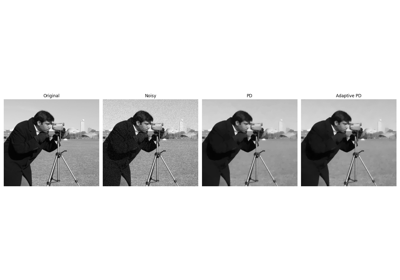
pyproximal.optimization.primaldual.AdaptivePrimalDual#
- pyproximal.optimization.primaldual.AdaptivePrimalDual(proxf: ProxOperator, proxg: ProxOperator, A: LinearOperator, x0: ndarray[tuple[Any, ...], dtype[_ScalarT]], tau: float, mu: float, alpha: float = 0.5, eta: float = 0.95, s: float = 1.0, delta: float = 1.5, z: Optional[ndarray[tuple[Any, ...], dtype[_ScalarT]]] = None, niter: int = 10, tol: float = 1e-10, callback: Optional[Callable[[ndarray[tuple[Any, ...], dtype[_ScalarT]]], None]] = None, show: bool = False) Tuple[ndarray[tuple[Any, ...], dtype[_ScalarT]], Tuple[ndarray[tuple[Any, ...], dtype[_ScalarT]], ndarray[tuple[Any, ...], dtype[_ScalarT]], ndarray[tuple[Any, ...], dtype[_ScalarT]]]][source]#
Adaptive Primal-dual algorithm
Solves the minimization problem in
pyproximal.optimization.primaldual.PrimalDualusing an adaptive version of the first-order primal-dual algorithm of [1]. The main advantage of this method is that step sizes \(\tau\) and \(\mu\) are changing through iterations, improving the overall speed of convergence of the algorithm.- Parameters
- proxf
pyproximal.ProxOperator Proximal operator of f function
- proxg
pyproximal.ProxOperator Proximal operator of g function
- A
pylops.LinearOperator Linear operator of g
- x0
numpy.ndarray Initial vector
- tau
float Stepsize of subgradient of \(f\)
- mu
float Stepsize of subgradient of \(g^*\)
- alpha
float, optional Initial adaptivity level (must be between 0 and 1)
- eta
float, optional Scaling of adaptivity level to be multipled to the current alpha every time the norm of the two residuals start to diverge (must be between 0 and 1)
- s
float, optional Scaling of residual balancing principle
- delta
float, optional Balancing factor. Step sizes are updated only when their ratio exceeds this value.
- z
numpy.ndarray, optional Additional vector
- niter
int, optional Number of iterations of iterative scheme
- tol
int, optional Tolerance on residual norms
- callback
callable, optional Function with signature (
callback(x)) to call after each iteration wherexis the current model vector- show
bool, optional Display iterations log
- proxf
- Returns
- x
numpy.ndarray Inverted model
- steps
tuple Tau, mu and alpha evolution through iterations
- x
Notes
The Adative Primal-dual algorithm share the the same iterations of the original
pyproximal.optimization.primaldual.PrimalDualsolver. The main difference lies in the fact that the step sizestauandmuare adaptively changed at each iteration leading to faster converge.Changes are applied by tracking the norm of the primal and dual residuals. When their mutual ratio increases beyond a certain treshold
deltathe step lenghts are updated to balance the minimization and maximization part of the overall optimization process.- 1
T., Goldstein, M., Li, X., Yuan, E., Esser, R., Baraniuk, “Adaptive Primal-Dual Hybrid Gradient Methods for Saddle-Point Problems”, ArXiv, 2013.