
Note
Go to the end to download the full example code.
Quadratic#
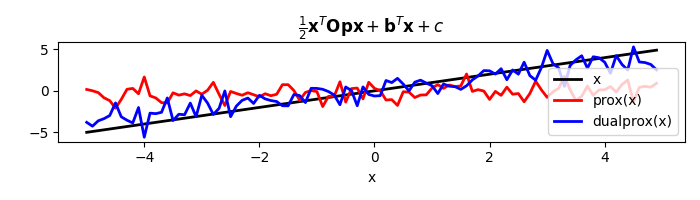
In this example we consider the proximal operator for a quadratic function:
\[\frac{1}{2} \mathbf{x}^T \mathbf{Op} \mathbf{x} + \mathbf{b}^T
\mathbf{x} + c.\]
which is implemented by the pyproximal.Quadratic class.
import numpy as np
import matplotlib.pyplot as plt
import pylops

import pyproximal

plt.close('all')
To start with cosider the most complete case when both \(\mathbf{Op}\) and \(\mathbf{Op}\) are non-null.
x = np.arange(-5, 5, 0.1)
nx = len(x)

A = np.random.normal(0, 1, (nx, nx))
A = A.T @ A
c = 2.
quad = pyproximal.Quadratic(Op=pylops.MatrixMult(A), b=np.ones_like(x), c=c,
                            niter=500)
print('1/2 x^T Op x + b^T x + c: ', quad(x))

tau = 4
xp = quad.prox(x, tau)
xdp = quad.proxdual(x, tau)

plt.figure(figsize=(7, 2))
plt.plot(x, x, 'k', lw=2, label='x')
plt.plot(x, xp, 'r', lw=2, label='prox(x)')
plt.plot(x, xdp, 'b', lw=2, label='dualprox(x)')
plt.xlabel('x')
plt.title(r'$\frac{1}{2} \mathbf{x}^T \mathbf{Op} \mathbf{x} + '
          r'\mathbf{b}^T \mathbf{x} + c$')
plt.legend()
plt.tight_layout()
1/2 x^T Op x + b^T x + c: 32762.596202322446
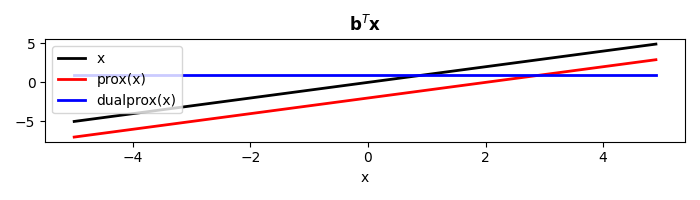
If we now assume that the operator \(\mathbf{Op}\) is null, the quadratic operator can be used to define the dot-product between \(\mathbf{x}\) and a vector \(\mathbf{b}\)
x = np.arange(-5, 5, 0.1)

dot = pyproximal.Quadratic(b=np.ones_like(x))
print('b^T x: ', quad(x))

tau = 2
xp = dot.prox(x, tau)
xdp = dot.proxdual(x, tau)

plt.figure(figsize=(7, 2))
plt.plot(x, x, 'k', lw=2, label='x')
plt.plot(x, xp, 'r', lw=2, label='prox(x)')
plt.plot(x, xdp, 'b', lw=2, label='dualprox(x)')
plt.xlabel('x')
plt.title(r'$\mathbf{b}^T \mathbf{x}$')
plt.legend()
plt.tight_layout()
b^T x: 32762.596202322446
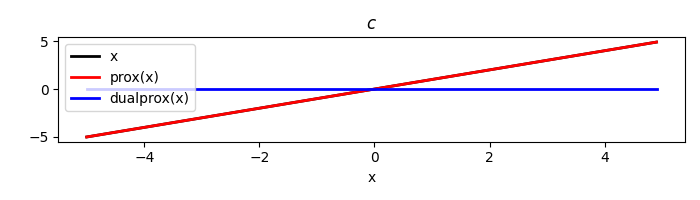
Finally if also \(\mathbf{b}\) is zero, the quadratic function reduces to a constant \(\mathbf{c}\) and its proximity operator becomes the vector \(\mathbf{x}\) itself.
x = np.arange(-5, 5, 0.1)

dot = pyproximal.Quadratic(c=5.)
print('c: ', quad(x))

tau = 2
xp = dot.prox(x, tau)
xdp = dot.proxdual(x, tau)

plt.figure(figsize=(7, 2))
plt.plot(x, x, 'k', lw=2, label='x')
plt.plot(x, xp, 'r', lw=2, label='prox(x)')
plt.plot(x, xdp, 'b', lw=2, label='dualprox(x)')
plt.xlabel('x')
plt.title(r'$c$')
plt.legend()
plt.tight_layout()
c: 32762.596202322446
Total running time of the script: (0 minutes 0.324 seconds)