 PyProximal
pyproximal.Quadratic
- class pyproximal.Quadratic(Op: LinearOperator | None = None, b: ndarray[tuple[Any, ...], dtype[_ScalarT]] | None = None, c: float = 0.0, niter: int = 10, x0: ndarray[tuple[Any, ...], dtype[_ScalarT]] | None = None, warm: bool = True)[source]
Quadratic function proximal operator.
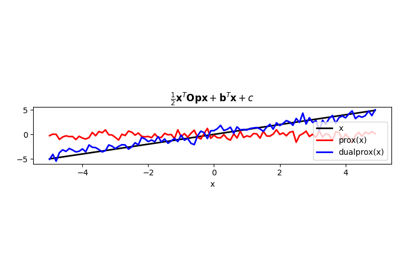
Proximal operator for a quadratic function: \(f(\mathbf{x}) = \frac{1}{2} \mathbf{x}^T \mathbf{Op} \mathbf{x} + \mathbf{b}^T \mathbf{x} + c\).
- Parameters:
- Op
pylops.LinearOperator, optional Linear operator (must be square)
- b
numpy.ndarray, optional Vector
- c
float, optional Scalar
- niter
int, optional Number of iterations of iterative scheme used to compute the proximal
- x0
numpy.ndarray, optional Initial vector
- warm
bool, optional Warm start (
True) or not (False). Uses estimate from previous call ofproxmethod.
- Op
- Raises:
- ValueError
If
Opis not square
Notes
The Quadratic proximal operator is defined as:
\[\prox_{\tau f}(\mathbf{x}) = \left(\mathbf{I} + \tau \mathbf{Op} \right)^{-1} \left(\mathbf{x} - \tau \mathbf{b}\right)\]when both
Opandbare provided. This formula shows that the proximal operator requires the solution of an inverse problem. If the operatorOpis of kindexplicit=True, we can solve this problem directly. On the other hand ifOpis of kindexplicit=False, an iterative solver is employed. In this case it is possible to provide a warm start via thex0input parameter.When only
bis provided, the proximal operator reduces to:\[\prox_{\mathbf{b}^T \mathbf{x} + c}(\mathbf{x}) = \mathbf{x} - \tau \mathbf{b}\]Finally if also
bis not provided, the proximal operator of a constant function simply becomes \(\prox_c(\mathbf{x}) = \mathbf{x}\)Methods
__init__([Op, b, c, niter, x0, warm])affine_addition(v)Affine addition
chain(g)Chain
grad(x)Compute gradient
postcomposition(sigma)Postcomposition
precomposition(a, b)Precomposition
prox(**kwargs)proxdual(**kwargs)