 PyProximal
pyproximal.optimization.primal.TwIST
- pyproximal.optimization.primal.TwIST(proxg: ProxOperator, A: LinearOperator, b: ndarray[tuple[Any, ...], dtype[_ScalarT]], x0: ndarray[tuple[Any, ...], dtype[_ScalarT]], alpha: float | None = None, beta: float | None = None, eigs: tuple[float, float] | None = None, niter: int = 10, callback: Callable[[ndarray[tuple[Any, ...], dtype[_ScalarT]]], None] | None = None, show: bool = False, returncost: bool = False) ndarray[tuple[Any, ...], dtype[_ScalarT]] | tuple[ndarray[tuple[Any, ...], dtype[_ScalarT]], ndarray[tuple[Any, ...], dtype[_ScalarT]]][source]
Two-step Iterative Shrinkage/Threshold
Solves the following minimization problem using Two-step Iterative Shrinkage/Threshold:
\[\mathbf{x} = \argmin_\mathbf{x} \frac{1}{2} ||\mathbf{b} - \mathbf{Ax}||_2^2 + g(\mathbf{x})\]where \(\mathbf{A}\) is a linear operator and \(g(\mathbf{x})\) is any convex function that has a known proximal operator.
- Parameters:
- proxg
pyproximal.ProxOperator Proximal operator of g function
- A
pylops.LinearOperator Linear operator
- b
numpy.ndarray Data
- x0
numpy.ndarray Initial vector
- alpha
float, optional Positive scalar weight (if
None, estimated based on the eigenvalues of \(\mathbf{A}\), see Notes for details)- beta
float, optional Positive scalar weight (if
None, estimated based on the eigenvalues of \(\mathbf{A}\), see Notes for details)- eigs
tuple, optional Largest and smallest eigenvalues of \(\mathbf{A}^H \mathbf{A}\). If passed, computes alpha and beta based on them.
- niter
int, optional Number of iterations of iterative scheme
- callback
callable, optional Function with signature (
callback(x)) to call after each iteration wherexis the current model vector- show
bool, optional Display iterations log
- returncost
bool, optional Return cost function
- proxg
- Returns:
- x
numpy.ndarray Inverted model
- j
numpy.ndarray Cost function
- x
Notes
The TwIST algorithm can be expressed by the following recursion:
\[\mathbf{x}^{k+1} = (1-\alpha) \mathbf{x}^{k-1} + (\alpha-\beta) \mathbf{x}^k + \beta \prox_{g} (\mathbf{x}^k + \mathbf{A}^H (\mathbf{b} - \mathbf{A}\mathbf{x}^k)).\]where \(\mathbf{x}^{1} = \prox_{g} (\mathbf{x}^0 + \mathbf{A}^T (\mathbf{b} - \mathbf{A}\mathbf{x}^0))\).
The optimal weighting parameters \(\alpha\) and \(\beta\) are linked to the smallest and largest eigenvalues of \(\mathbf{A}^H\mathbf{A}\) as follows:
\[\begin{split}\alpha = 1 + \rho^2 \\ \beta =\frac{2 \alpha}{\Lambda_{max} + \lambda_{min}}\end{split}\]where \(\rho=\frac{1-\sqrt{k}}{1+\sqrt{k}}\) with \(k=\frac{\lambda_{min}}{\Lambda_{max}}\) and \(\Lambda_{max}=max(1, \lambda_{max})\).
Experimentally, it has been observed that TwIST is robust to the choice of such parameters. Finally, note that in the case of \(\alpha=1\) and \(\beta=1\), TwIST is identical to IST.
Examples using pyproximal.optimization.primal.TwIST
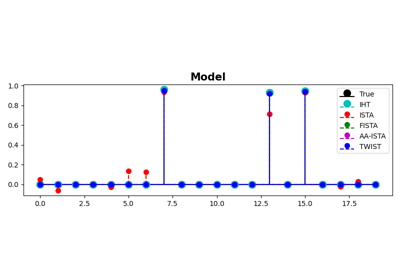
IHT, ISTA, FISTA, AA-ISTA, and TWIST for Compressive sensing