 PyProximal
Note
Go to the end to download the full example code.
Concave penalties
This example considers proximal operators of concave separable penalties.
import matplotlib.pyplot as plt
import numpy as np

import pyproximal

plt.close("all")
x = np.linspace(-5, 5, 101)


def compare_penalty_and_proximal_operator(penalty):
    fig, ax = plt.subplots(1, 2)
    ax[0].plot(x, penalty.elementwise(x), label=penalty.__class__.__name__)
    ax[0].plot(x, np.abs(x), "k--", label="l1")
    ax[0].set_aspect(2)
    ax[0].set_xlim(-5, 5)
    ax[0].set_ylim(0, 5)
    ax[0].set_title("Penalty")
    ax[0].legend(loc="upper center")
    for tau in [0.25, 0.50, 0.75, 1.00]:
        ax[1].plot(x, penalty.prox(x, tau), label=f"tau={tau:.2f}")
    ax[1].plot(x, x, "k--")
    ax[1].set_aspect("equal", "box")
    ax[1].set_xlim(-5, 5)
    ax[1].set_ylim(-5, 5)
    ax[1].set_title("Proximal operator")
    ax[1].legend(loc="upper left")
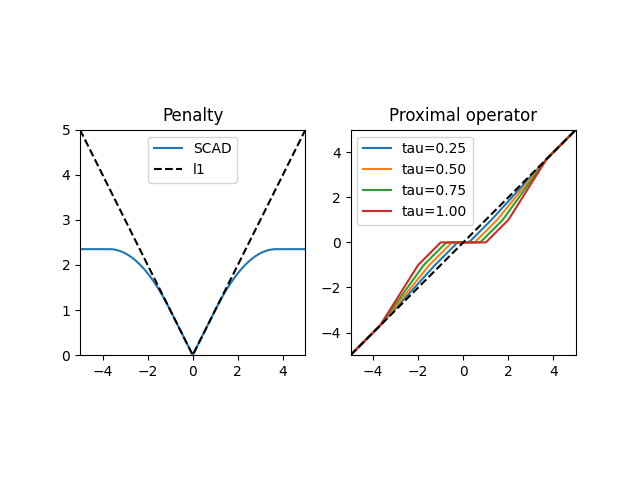
The SCAD penalty combines both soft-thresholding and hard-thresholding in a continuous manner
scad = pyproximal.SCAD(1, 3.7)
compare_penalty_and_proximal_operator(scad)
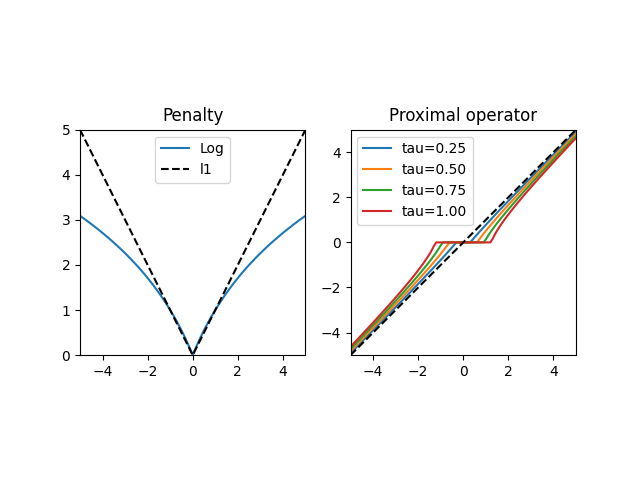
The Log penalty encourages sparsity more than the l1-penalty and parametrizes a family of functions which lie between l0 and l1-penalties.
log = pyproximal.Log(1, 0.5)
compare_penalty_and_proximal_operator(log)
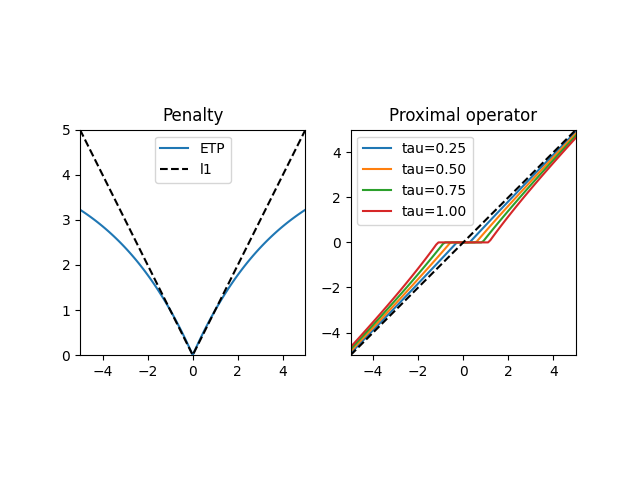
The ETP penalty is similar to the Log penalty in that it tends to the l1-penalty and the l0-penalty at its extremes.
etp = pyproximal.ETP(1, 0.25)
compare_penalty_and_proximal_operator(etp)
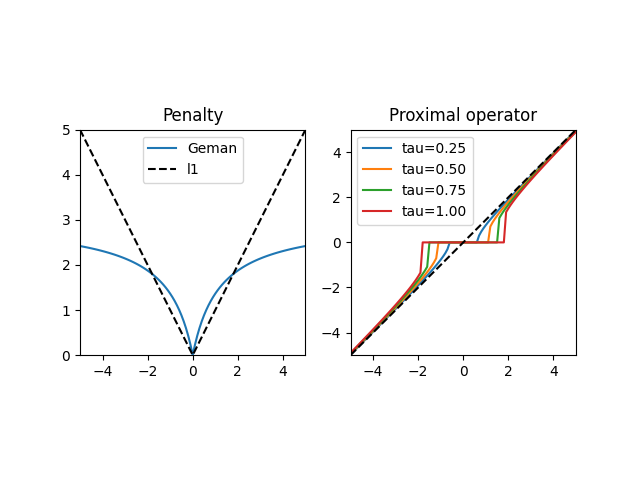
The Geman penalty
geman = pyproximal.Geman(3, 1.2)
compare_penalty_and_proximal_operator(geman)
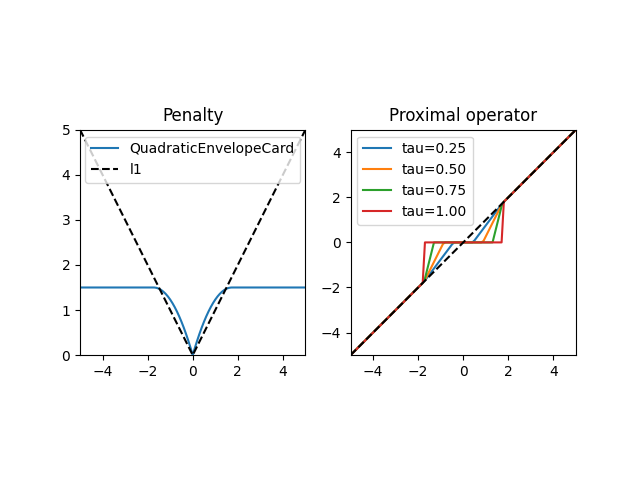
The quadratic envelope of the l0-penalty
f_mu = pyproximal.QuadraticEnvelopeCard(1.5)
compare_penalty_and_proximal_operator(f_mu)
Total running time of the script: (0 minutes 0.408 seconds)