
 PyProximal
pyproximal.optimization.primal.TwIST
- pyproximal.optimization.primal.TwIST(proxg: ProxOperator, A: LinearOperator, b: ndarray[tuple[Any, ...], dtype[_ScalarT]], x0: ndarray[tuple[Any, ...], dtype[_ScalarT]], alpha: float | None = None, beta: float | None = None, eigs: tuple[float, float] | None = None, niter: int = 10, tol: float | None = None, rtol: float | None = None, callback: Callable[[ndarray[tuple[Any, ...], dtype[_ScalarT]]], None] | None = None, show: bool = False, itershow: tuple[int, int, int] = (10, 10, 10), returncost: bool = False) ndarray[tuple[Any, ...], dtype[_ScalarT]] | tuple[ndarray[tuple[Any, ...], dtype[_ScalarT]], ndarray[tuple[Any, ...], dtype[_ScalarT]]][source]
Two-step Iterative Shrinkage/Threshold
Solves the following minimization problem using Two-step Iterative Shrinkage/Threshold:
\[\mathbf{x} = \argmin_\mathbf{x} \frac{1}{2} ||\mathbf{b} - \mathbf{Ax}||_2^2 + g(\mathbf{x})\]where \(\mathbf{A}\) is a linear operator and \(g(\mathbf{x})\) is any convex function that has a known proximal operator.
- Parameters:
- proxg
pyproximal.ProxOperator Proximal operator of g function
- A
pylops.LinearOperator Linear operator
- b
numpy.ndarray Data
- x0
numpy.ndarray Initial vector
- alpha
float, optional Positive scalar weight (if
None, estimated based on the eigenvalues of \(\mathbf{A}\), see Notes for details)- beta
float, optional Positive scalar weight (if
None, estimated based on the eigenvalues of \(\mathbf{A}\), see Notes for details)- eigs
tuple, optional Largest and smallest eigenvalues of \(\mathbf{A}^H \mathbf{A}\). If passed, computes alpha and beta based on them.
- niter
int, optional Number of iterations of iterative scheme
- tol
float, optional Tolerance on change of objective function (used as stopping criterion). If
tol=None, run untilniteris reached- rtol
float, optional Relative tolerance on objective function wrt initial value. Stops the solver when the ratio of the current objective function to the initial objective function is below this value. If
rtol=None, run untilniteris reached or the other tolerance criterion is met- callback
callable, optional Function with signature (
callback(x)) to call after each iteration wherexis the current model vector- show
bool, optional Display iterations log
- itershow
tuple, optional Display set log for the first N1 steps, last N2 steps, and every N3 steps in between where N1, N2, N3 are the three element of the list.
- returncost
bool, optional Return cost function
- proxg
- Returns:
- x
numpy.ndarray Inverted model
- j
numpy.ndarray, optional Cost function
- x
Notes
Examples using pyproximal.optimization.primal.TwIST
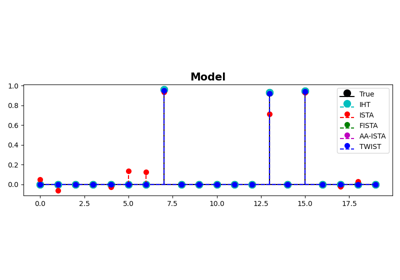
IHT, ISTA, FISTA, AA-ISTA, and TWIST for Compressive sensing